


The Proposition
Australian director John Hillcoat's new film, The Proposition, erupts in a burst of bloodshed and bullets as a gang of "bushrangers" engage in a shootout with a raggedy band of policemen led by British law officer Captain Stanley (Ray Winstone). It's Stanley's job to rid the region of all good-for-naughts and he has his blazing gun-sights set on the notoriously brutal Burns brothers, who are recently most wanted for the ghastly rape and murder of a local pregnant woman.

After weathering the hail of bullets, Charlie Burns (Guy Pearce) and his fourteen-year-old brother Mikey are forced to surrender to Cpt. Stanley, who ultimately offers Charlie an intriguing proposition: if Charlie finds and kills his savage and elusive older brother, and leader of the Burns Gang, Arthur (Danny Huston) a pardon will be given to Charlie and Mikey. However, if Charlie fails to kill Arthur, on Christmas morning Mikey will be removed from the jail, ensuring that on that day - much to the delight of locals hungry for revenge - more than just mere stockings will be hung.
That's the basic setup for The Proposition - a film that is fueled more by brutal realism than nostalgic romanticism, and is simply the best Western to come down the pike in many a moon.

Director John Hillcoat has fashioned a Western that, while specific to the Australian Outback of the 1880s in which it is set, is also rooted in the Western traditions which many moviegoers, and you can count me among them, are yearning to see stirring up dust on the big screen once again. The Proposition is not merely a retread however. The film scripted by singer/songwriter Nick Cave (in a purported three weeks no less!) is an unabashed throwback to classic Western archetypes and themes, but the material has enough imagination and originality that it never feels tedious, or simply redundant. Without giving away details which might compromise the film, suffice it to say, at times the story also seems to use familiar setups as a way of playing with genre stereotypes and audience expectations, which it then slightly subverts, to somewhat surprising, if not altogether "rousing" effect.
As mentioned, Cave and director John Hillcoat seem to have approached the material with a focus on realism over artifice, or any old-timey romantic notions about violence. The Proposition is an often brutal and ugly film. All the same, the jarring in-your-face bloodshed is not poured on for entertainment value, but rather, as the grisly and unsettling outcome of men destined to clash in an awe-inspiring yet unforgiving landscape ruled by ruthless brutality.

The look of the film complements the story perfectly, balancing the oft-times beautiful and harsh elements that are prevalent to both the Outback, and the story in which it is set. Cinematographer Benoit Delhomme does an excellent job capturing the glorious beauty of a multi-hued sunset, or a sparkling, star-dappled night sky against a silhouette of naked tree branches. He then contrasts such eye-catching imagery with the deadly, rippling blaze of the sun, or an immense buzzing cloud of flies - an omnipresent harbinger of death that crawls into mouths and literally covers people's clothing. In addition to this, the radiating heat of the desert is almost tangible throughout The Proposition - the fiery eye of the sun seemingly unrelenting as it beats down on the film's sweat-soaked, grime-caked characters.
Thematically the film makes good use of the contrast between the emerging civilization and the "uncivilized" violence that is a result of that burgeoning community's attempt to tame an "untamed" land. To be sure, much of the film's conflict relies on this balance, which proves to be anything but harmonious. As refinements of modern civilization tend to give way under the strain caused by the harsh desert locale, a clash with primitive survival instincts emerges, and violence appears to supersede any notions of civility.

The character Arthur Burns, an intelligent, educated man who is also perhaps the most savagely violent character in The Proposition, is also the one person who appears to have reconciled the two, attaining a personal balance by embracing his primitive violent tendencies with the cultural refinement he obviously possesses. The fact that many of the Aboriginal tribesmen in the area believe that Arthur is a man that transforms into an animal underscores this concept.
In relation to this, the characters Cpt. Stanley, a civil authority, and Charlie Burns, a criminal, might appear to be at opposite ends of the struggle between civil order and barbarous acts, but both epitomize this conflict for balance, their parallel story arcs mirroring each other, and effectively dovetailing by film's end. Overall, this conflict at the heart of the film and its characters is an intriguing aspect of The Proposition, and one which enriches the overall viewing experience.

Another of the film's highlights is a truly remarkable cast. Apart from the lead actors already mentioned, and who all do great work, Emily Watson plays the role of Emma - Cpt. Stanley's genteel British wife who has been transplanted to the inhospitable Australian desert environs, and whom Cpt. Stanley struggles desperately to shield the violent realities of his occupation from. Also, the great John Hurt appears as a grizzled bounty hunter named Jellon Lamb, patiently biding his time in an attempt to eventually nab the elusive, verging on mythical, eldest Burns brother, Arthur. Last, David Wenham, most famous for his role as Faramir in the Lord of the Rings Trilogy, does an outstanding job playing Cpt. Stanley's despicable, bloodthirsty superior, Eden Fletcher.
To be certain, The Proposition is obviously not for moviegoers hoping for light entertainment, nor does it aim to be a feel-good shoot 'em up crowd-pleaser. Also, Western fans hoping for lasso tricks and campfire sing-alongs simply need not apply. Instead, The Proposition offers a really well-made, engrossing film, with interesting and believable characters, and some excellent performances. The subject matter is dark, at times verging on nihilistic, and the filmmakers are unflinching in their approach to the material and violence without being excessive. While I don't foresee the film doing a "dough-si-dough" at the box-office, The Proposition is a damn fine movie that will hopefully find an audience. For fans of the Western genre's more uncompromising films, it's a movie not to be missed.
Tweet
Originally published at Horrorview.com
Labels: film, guy pearce, john hillcoat, nick cave, review, the proposition

Slither (2006)
The new horror-comedy Slither, written and directed by James Gunn, quickly sets the tone, revealing both its intentions and influences with an appropriately traditional opening shot that recalls many a sci-fi/monster movie.A meteor hurtles through outer space, while in the big, black void beyond, we see the planet Earth, spinning like a bright blue bull's-eye... the perfect target for space debris of the traditionally villainous variety. Meanwhile on Earth, in the small town of Wheelsy, a seemingly dim-witted police duo whittle away the evening inside their police cruiser as, unbeknownst to them, the smoldering meteor suddenly blazes across the night sky, crashing in the not-too-distant distance.
It's the dawn of deer hunting season in Wheelsy, and Wheelsians young and old are ready and raring to reassert their rightful place atop the old food chain high above their antlered inferiors. Coincidentally, sexy school teacher Starla Grant (Elizabeth Banks) is busy discoursing on Darwin's theory of evolution. Being a young and attractive woman, it's not surprising that Starla's distracted students are far more ardent in their amour for their curvaceous teacher than they are for any of that dusty old Darwinism, of which Starla seems the sole devotee.
 Sharing in her student's lustful sentiments is Starla's oldster hubby Grant Grant (Michael Rooker), who is very much devoted to his wife. All the same, it becomes clear that things are not all rosy and racy at home when later that evening, Grant attempts to give vent to his passions with a suggestion of sex, and Starla rebuffs his advances, apologizing for not being in the mood. Withered and woebegone, Grant wends his way towards a tavern to give his sorrows a proper Pabst Blue Ribbon beer bath.
Seated in the bar and hunkered behind a bunker of beer bottles, Grant is approached by a fellow lonely-heart named Brenda. Soon thereafter the lovelorn twosome are traipsing and tripping through the woods when Grant stumbles upon a strange, goo-strewn pod. After engaging in some tried and true backwoods science by prodding the pod with a carefully chosen stick, something erupts and shoots from the pod, and appears to enter Grant's body. Confused, but believing he is okay, Grant hurries home to his beloved Starla. Despite his beliefs, over the next couple of days Grant's appetites continue to grow and expand, and his insatiable voracity begins to emerge in the form of bodily mutations. With small town life suddenly spinning out of control, an unimaginable horror continues to evolve, adding a new link to the food chain, and ensuring that before long hunters will become the hunted, now that humans are on the menu.
Horror-comedies are indeed a tricky lot. The tightrope walk between what is frightful and what is funny often proves too precarious a permutation, sending movies that aim to have audiences scream in terror one minute and shriek with laughter the next, rapidly plummeting in a fiery heap to their blazing box-office deaths. Even so, there are those occasions when the balance between horror and hilarity is just right. This result can be a unique film hybrid that succeeds in evoking two of our most basic human responses, and combining two popular movie genres, that on the surface, seem completely dissimilar.
Certainly, there are plenty of horror movies that briefly utilize humor for comic relief, or at the opposite end, films like Young Frankenstein or the Scary Movie franchise which are strictly comedies spoofing popular horror films. Still, neither of these "types" are horror-comedies in the truest sense. With this in mind however, for the perfect example of a film that truly does fit the bill, one need look no further than James Gunn's monstrously funny fright-film, Slither.
When watching Slither, Gunn's directorial debut, one can sense the pure joy and adoration the director/screenwriter has for horror movies as throughout the film Gunn proudly displays his numerous inspirations like a badge of honor. Whether its David Cronenberg's '70s shockers, Shivers and Rabid, low-budget sci-fi horror like The Deadly Spawn, or Frank Henenlotter's humorous '80s horror hybrids, Slither is a blood-drenched, slime-covered love letter that gives horror film enthusiasts something to celebrate. At the same time, one need not be a "horror buff" to enjoy Slither however, as it is just a fun, highly likeable movie in general, and as such, should prove an entertaining, and possibly disgusting, viewing experience even to audience members unfamiliar with the film's predecessors, or who may miss the various winks and nods.
Although Slither's basic story cannot be lauded for being innovative, necessarily, it is really quite clear that this was not one of Gunn's concerns, nor apparently, an aspiration. Rather, he has managed, quite handily, to rejuvenate some rather worn-out horror movie concepts and conventions with an abundance of wit, humor - and yes - originality. For this reason Slither never feels stale, or like the slimy "creatures featured" in the film, sluggish. This is of course a breath of fresh air in a genre that, truth be told, has begun to feel as imaginatively stagnant as someone who uses phrases like, "a breath of fresh air."
In his director's chair debut, James Gunn does an exceptional job bringing his ideas to life onscreen. Visually, the film is not overly extravagant but nor is it boring, and the somewhat restrained, deceptively simple approach benefits the film overall. The special effects are a successfully effective melding of the traditional variety with state of the art CG, and what may have perhaps looked like cheesy, hackneyed hokum in another film, actually works quite wonderfully here.
The cast does a very fine job in Slither, and the major characters that populate the film, while not profound or multilayered (which they need not be), are really nicely written. Despite numerous recent examples, and plenty of opinions to the contrary, Slither also proves that characters in horror films, even if they are simple, can be likeable. Unlike their multi-tentacled, slime-coated, blood-quaffing counterparts, the main human characters that the audience is supposed to relate to, or at the very least get behind in Slither, are engaging, oft-times funny, in some cases moderately intelligent, and for all of these reasons, decidedly human and easy to root for. Thankfully Slither also employs the classic monster movie tradition (think of the well-known Frankenstein monster for an example) wherein those aspects of the creature that are identifiably human still manage to emerge from beneath all of the deformities and ugliness, thus making the "monster" a somewhat sympathetic and ultimately tragic figure.
Apart from perhaps a couple of very brief lulls in Slither, the film is without any major problems. In all it is simply a very lively, highly-entertaining, tightly-scripted, out-and-out funny horror movie that should have some audience members squirming in their seats. Fans of recent horror-comedies like Dead & Breakfast, or Bubba Ho-tep should also have a lot of fun with Slither - a movie that is truly the best laugh-filled fright film since Shaun of the Dead and a gruesome gut-buster bound to become a horror-comedy classic. Now don't let my slutty quote whoring hinder you - just get to the theater and have yourself a bloody good time!
Originally published at Horrorview.com
Labels: film, james gunn, review, slither

Hostel (2005)
In horror "wunderkind" Eli Roth's second feature film Hostel, a duo of foolhardy, Europe-traipsing, pleasure-mongering college graduates with marijuana in their lungs, pussy on their brains, and law careers in their future, are looking to get their groove on in what is infamously the grooviest of all European cities, Amsterdam. Realizing somewhere along the way that three's company too, the hedonistic American tourists, who are named Paxton and Josh, have teamed up with a like-minded debauchee from Iceland named Oli.
Inside a discotheque things begin looking up as Paxton and Josh whisper sweet nothings to a couple of local cuties. However, when Josh inadvisably draws attention to his dorky fanny pack by reaching into it to buy a round of drinks, the girls vamoose, which in turn, results in a stern lecture from Paxton. With frustration mounting, booze saturating his brain, and his fanny pack growing more burdensome by the minute, Josh then puts the moves on the wrong gal. A scrap with her Legolas look-alike boyfriend quickly escalates, and inevitably, our thrill-happy threesome gets tossed out of the club.
With but a little wind left in their once blustery sails, Paxton, Josh and Oli make haste to a nearby brothel. Once inside the garishly lit brothel, Oli and Paxton continue their haste-making ways, while Josh, who has some reservations about the whole prostitution thing, mills about, poking only his curious head into the occasional moan-filled room.
Afterwards, the guys return to the dingy hostel in which they are staying, but much to their chagrin, discover that they have been locked out. After pounding at the door and damning all of Europe, a rain of beer bottles from some sleepy second story neighbors send all three scampering toward an open window where a friendly lad named Alexi bids them welcome. Inside the cozy room Paxton, Josh and Oli listen attentively as their gracious and loquacious host gives them the jaw-slackening details about a Hostel in Slovakia where the girls are both beautiful and easy. This basic equation sends the boys packing, however, unbeknownst to them things are not quite as simple as they seem, and ultimately sex in Slovakia... just might equal death.
As much as I wanted to enjoy Hostel, I'm afraid I left the star-studded screening a little disappointed. One of my chief problems with the film was the characters; I simply did not like them very much. I am not entirely certain Eli Roth wanted his characters to be the stereotypical loud, obnoxious, ignorant tourists that are both a bane and an embarrassment, (and all too commonly from the United States) but if so, he succeeded admirably.
Yet, I am quite certain he wanted us to like his characters - at least on some very basic levels - but to a large degree I found this a difficult task. No, the characters do not do anything too terrible, (although the homophobic slurs they continually spout really wore on me) and certainly nothing that warrants the violence that befalls them. Nevertheless, not really liking or caring about the characters engendered a feeling of detachment towards them and the film, and as a result, the "horror" elements were rendered impotent, further reducing the "horrific" plight of the characters to the "ouch, that's gotta hurt" variety.
The film also appears to have some fairly interesting concepts, but in almost every instance Roth either abandons, undermines, or bungles his good ideas. For example, the impetus for Hostel was based on an actual website that frightened and disgusted Roth. In his words, 'People are sick. There are no limits to what they will do to another person for their own pleasure, and that's the most horrifying thing of all." This notion is central to Hostel - or at least half of it.
Though he never succeeds in translating the horror, disgust and contempt that he originally felt, and which reportedly spawned the film, Hostel does revolve around the concept of people indiscriminately using other people for their own pleasures - and for a short time, it works pretty well. Nevertheless, Roth completely contradicts, and by doing so, undermines his own central concept when he switches gears, making violence and death something to laugh and cheer about ( which isn't a problem in and of itself, it just doesn't work in Hostel). In one respect, this could be seen as a subversive move on Roth's part - revealing that the audience is also able to derive pleasure from the pain of others, (even if it is just imaginary suffering) and thus solidifying his view that "people are sick." However, based on his own comments in the Q&A that followed the film, and the fact that Hostel is riddled with conceptual inconsistencies and disappointments, to suspend my disbelief and call Roth and his film subversive would completely exhaust the little bit of generosity I'm saving for the latter part of this review.
Yes, the film lacks consistency, however, it is at times quite entertaining. In spite of Roth's claims that he wanted to create "a pure horror film - one that starts out fun, but gets darker and darker and never looks back and winks at the audience," Hostel does do a lot of winking, and the film's dark sense of humor, though contrary to aspects of Roth's "vision," was something I enjoyed about film.
Along these lines, the special effects from KNB were quite well done (as usual), even if Hostel is not nearly as over-the-top violent as its director seems to think that it is. Also, Quentin Tarantino is quoted as saying, in reference to Hostel, "No one's ever seen anything like this," which is a quote someone with his vast knowledge of film should be ashamed to have uttered. Hostel's influences, which are substantially better films like The Vanishing, The Wicker Man, Audition, The Marathon Man, also stretches into the realm of violence, which is at times an ode to directors that range from the likes of Lucio Fulci and Park Chan-Wook. And, while Hostel won't "surprise hard core genre fans" (Roth again) it does aim to please fans of gore, and should prove a moderate success in doing so.
I would say that Eli Roth has improved as a director, although it could be argued that a substantially bigger budget and a seasoned film crew are to blame. Aesthetically Hostel is superior to Cabin Fever. The cinematography, art direction and locations all combine to create a great sense of atmosphere that elevates the film. In terms of the acting, there isn't really a bad performance, and as some of the actors had very little experience, I believe the director does deserve some credit.
I imagine I will probably be in the minority, but as you can easily tell, I did not enjoy Hostel very much. I think the film would be more enjoyable if it were not being advertised and lauded as this scary, depraved, ultra-violent horror film. Yes it's just about as violent as conservative studio films dare to be these days, yet it's truthfully just an average piece of popcorn entertainment that can be better appreciated if viewed as such. Lastly, if indeed Eli Roth aspires to, as he says, "push the envelope," I think he might have more success if he focused on a new career with the U.S. Postal Service and left the movie-making to the Asian filmmakers he graciously praises, and so desperately hopes to emulate.
Originally published at Horrorview.com
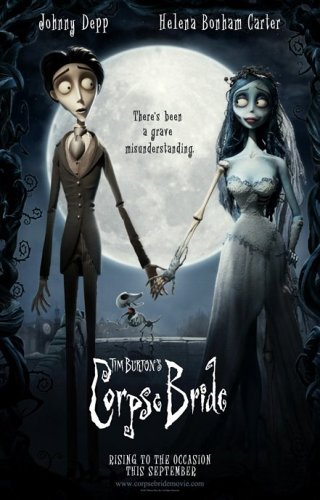
Corpse Bride (2005)
To be perfectly honest there are few sights more heart-wrenching than that of a twenty-something wearing a Jack Skellington beanie, looking more forlorn than usual after a midnight screening of a new Tim Burton film. However, twas last night that I saw such a sight and also found myself feeling somewhat similar - a tad cheerless -but thankfully without that itchy feeling for which beanies are a notorious culprit. Some people say you either love Tim Burton (referring to his films, I imagine) or you hate him. Yet, being someone prone to falling in the middle, and believing people who dichotomize such things should be slapped mercilessly with a pair of dirty, gray tube-socks, I neither love nor hate Tim Burton (referring to his films, of course!) and therefore fall into the "like" category. One of his films that I like quite a lot is The Nightmare Before Christmas. Yes, he did not direct that film, but certainly a fingerprint analysis would not be required to determine that "Nightmare" is very much a Tim Burton film. I am also very fond of stop-motion animation, and so, it would be true to say my anticipation of Corpse Bride was indeed two-fold.
The film begins with the nebbish Victor Van Dort (voiced by Johnny Depp) being ushered along by his fishmongering parents to meet the fetching lass, Victoria Everglot (Victor/Victoria) he is soon to marry. It is an arranged marriage, and as such, it is a union made to benefit the parents of both bride and groom. However, all is not as it seems, and perhaps if it were not for their trade, the parents Van Dort would notice that something smells a little fishy.
After Victor and Victoria meet, things quickly go from clumsy to cozy, and fate being the fickle bitch that she is, it appears the two are ready to spend the rest of their lives with one another after only a few minutes. However, shortly thereafter, when Victor continually flubs his vows during the wedding rehearsal, the cantankerous Pastor Gallswells (voiced by a wonderfully thunderous Christopher Lee) boots Victor out of the church and tells him not to return until he gets his act straight. Victor then wanders out into the nearby woods and begins practicing his wedding vows, culminating in his placing a wedding ring on a gnarly branch that actually turns out to be the hand of the titular Corpse Bride. In a jarring turn of events, Victor now finds himself betrothed to a dead woman and thrust from the gloomy land of the living and into the colorful underworld of the dead, where he must ultimately determine which bride he wants to spend the rest of his life, or death, with.
To be sure, Corpse Bride is not without its charms. I am sure it comes as no great surprise that the film looks nice - kind of like a collaboration between the Quay Brothers and Walt Disney. The gothic touches for which Burton is so fond (as am I) are on display in the dour and moody world of the living - which also serve as an effective contrast to the color saturated underworld of the dead. However, that being said, the visual scope is not as grand as it was in The Nightmare Before Christmas, and in comparison feels rather limited. On the plus side, the film also certainly boasts a very nice vocal cast! In addition to those already mentioned are, Emily Watson, Helena Bonham Carter, Albert Finney, Richard E. Grant, Tracy Ullman and Michael Gough (Hammer represent!) just to name a few.
The majority of the problems I had with the film are in the writing. Victor, the protagonist, is a very flimsy character. His basic wants and desires are ambiguous at best and he could simply be described as a pinball, bouncing from one character and scenario to the next. There is really no motivation or arc to Victor, apart from the fact that he bumbles a bit less by film's end. As for the Corpse Bride, she wants Victor to love her, well, because they're married I guess - even if it was an accident. She has a back story that sheds some light on things, but for the most part her character is not very interesting. Probably the most memorable thing about the Corpse Bride character was her sidekick, a maggot that looks and sounds like Peter Lorre and pops in and out of her head.
In addition to thin characters, the story is pretty scant as well. While there is conflict in the film's premise, often times as other conflicts arise they are set up only to be resolved in a quick and uninspired manner, and any drama quickly fizzles out. The film also hints at several interesting ideas, but fails to ever really do anything with them - almost as if someone forgot they were ever there. To make matters worse, the story then quickly deteriorates into predictability, and from about midway the film's ending is clearly in sight and its only a matter of the minor details being revealed. Sadly, even the songs by Danny Elfman are largely forgettable (and at times the lyrics are indiscernible) and pale in comparison to his other collaborations with Tim Burton.
The film clocks in at a mere 78 minutes and I think that with another fifteen minutes some of these problems could have been fixed, and the story and characters could definitely have used more time for some much needed fleshing out. It's common knowledge that animation is a painstaking, time-consuming process, and I can only imagine that if as much work had been put into the writing of the film, as went into animating it, Corpse Bride would have been much, much better. While not a disaster, the film just did not live up to my expectations, and if your expectations for this film are high then you might very well be disappointed. So, while I can't recommend the film I can offer one piece of advice however - if you own a Jack Skellington beanie, just leave it at home.
Originally published at Horrorview.com
Labels: corpse bride, film, review, tim burton

Wolf Creek (2005)
If you are an avid movie-watcher, and I'm willing to wager that many of you are, the chances are also good that you would be likely to concede that 2005 has really been a pitifully lackluster year for major film studio fare. Even those optimists who are soiling their nappies in anticipation that the razzle-dazzle of King Kong (me) or perhaps the first installment of The Chronicles of Narnia (6th grade English teachers everywhere) will end the year on a spectacular high note, might be reminded that one is a remake and the other an adaptation of a previous work - the very two things which studios suffering from imagination deprivation have sunk their fangs into, sucked the life out of, and then beaten audiences to death with throughout the year. So on that note, take a brief moment and turn your hopeful gaze away from the Kong camp in New Zealand and pay attention to nearby Australia, because a little horror film titled Wolf Creek - not a remake, not an adaptation, but easily one of the better films of 2005 - is just around the corner.
Based on some actual brutal murders (though how loosely I'm not sure) that made headlines in Australia, Wolf Creek's story centers on two British female tourists, Liz and Kristy, and their Australian friend Ben, as they make their way by car through the vast Australian outback toward an immense crater located in an area known as Wolf Creek. After an ominous and unsettling encounter with a group of burly browbeaters at a gas station, the threesome arrive at Wolf Creek, take in the awe-inspiring view, and then hike down into the heart of the crater.
As daylight dwindles, Ben, Liz and Kristy return to the car only to discover that the car won't start. In addition, all three are startled to find that their watches have also mysteriously stopped, prompting Ben to relate legends about UFOs and strange occurrences in the area. Ben is told to shut up, and then notices a cluster of lights in the distance, rapidly approaching. To their relief it turns out to be only a truck driven by a friendly, if somewhat eccentric outbacker named Mick Taylor.
Unlike their wristwatches, the diagnosis on the car ends up being more serious than just a battery problem, so Mick kindly offers to give them a tow back to his place where he has the parts to repair the car, assuring the threesome that he can get them back on the road and on their way by sunup. Despite some fleeting reservations, Kristy, Liz and Ben accept Mick's friendly offer, as the chance of anyone else coming along to help anytime soon is indeed a rather dim one. As Mick tows them through the darkness and deep into the outback, Kristy voices some concern - however, the three young travelers could never have fathomed the blood-drenched horrors that soon await them, or the unflinching level of vicious, depraved violence that will be inflicted by the hands of an absolutely sadistic killer.
Despite a setup that, based on the synopsis, might seem somewhat pedestrian, first time director (and screenwriter) Greg McLean has done a really stupendous job of taking some familiar, if not slightly shopworn ideas, and has infused them with enough originality and inventiveness that Wolf Creek never feels like just another retread down a dark, but frustratingly familiar, path. The basic story is also a simple one, twenty-somethings in peril and the serial killers who love them - however the film really does shine as a singular effort in a long, long line of serial killer films.
One of the strongest aspects of Wolf Creek is the pervasive sense of dread that it evokes. The film's setup is an extremely effective slow build in which feelings of foreboding and unease are intensified by the knowledge and anticipation that danger is imminent. It could be likened to a shark attack: you're in the ocean, a shark fin cuts through the dark water towards you and then submerges, disappearing. Completely helpless, the unbearable tension, knowing the beast could bite at any moment, is perhaps as excruciating as the bite itself. Wolf Creek is like this and the film makes for an incredibly tense viewing experience.
Certainly part of this is due to the film's preface which lets it be known that Wolf Creek is based on actual events. However, more than this it is the visual approach to the film which permeates the first half of Wolf Creek with an ominous sense of apprehension. Common things which might seem benign or even beautiful are filmed in such a way (sometimes verging on abstraction) that they are brimming with a sense of mystery, and, an even stronger feeling that all is not right. A setting sun, endless stretches of empty road, a magnificent crater, the moon... when the familiar becomes peculiar it can also become unsettling, and in Wolf Creek it does just that.
A strong sense of dread also exists in the film because of the characters. Many movies of this ilk are populated with people that are nothing more than walking targets with good cheekbones and bad dialogue. Yes, usually these characters are also annoying, so when the "fleshing out" of these "individuals" with either a hatchet, chainsaw, tennis racket (insert your weapon of choice) actually begins, so does the fun, and more often than not, the audience is cheering on the killer.
Wolf Creek is not this kind of "horror" film. The characters have been written and are portrayed in a very realistic manner; they could be a neighbor, a co-worker, or a best friend. While it is initially easy to distance yourself from the characters, as the film progresses you will find yourself growing to like them, empathizing with them, and in some cases, even identifying with them. This makes the tension that much greater, and the horrors that follow all the more terrifying.
While the first half of the film is dread-filled, the second half of Wolf Creek cranks everything up, becoming an unrelentingly hellish descent into cinematic savagery. Though at times gruesome, the film is not an over-the-top splatterfest. Yet, you can be certain, the violence is extremely effective and unpleasant and will have some audience members squirming in their seat. Even more likely to induce wriggling is the continual buildup of tension as the protagonists struggle to survive and the killer hunts its prey. Again, director Greg McLean does a remarkable job of keeping us on the edge and whitening our knuckles throughout the second half of the film. At the screening I attended there were maybe 10 people in a small screening room, however, the tension in the room was virtually palpable.
(Possible spoilers! Next three paragraphs.) Apart from being a downright evil son of a bitch, the film's killer, in a certain sense is almost like a mythical character. I know very little about Australia ( duh, I live in the U.S. so what do I care about the rest of the world), but I got the sense that the character (an outbacker from a similar mold as Mick Dundee) is the last of a dying breed - an almost larger than life personality, with a distinct way of surviving that has (or is) becoming obsolete, and as such, is being pushed into extinction.
While gathered around his campfire with the three travelers, the killer talks about the past when he was employed as a hunter whose job it was to "thin out the herd" in areas overrun with animals. Shortly thereafter he remarks that there are too many tourists (which is what Liz and Kristy are) and then makes a disparaging comment about people from the city (specifically Sydney, which is where Ben is from). While this could be construed as being a motivation for the killer, more to the point, it seemed an intriguing layer, or interesting facet to his character that the film hints at. This idea that the killer represents a rugged individual outbacker type that is vanishing from the population, and thus, has become a myth, is perhaps exemplified in the final shot of the film - an image which I won't ruin here (and which can be interpreted in multiple ways) .
Across the board the acting is very good. However, I would be remiss if I didn't single out John Jarratt's performance. It is a really frightening portrayal - it's gritty, believable, it's not romanticized, and Jarratt brilliantly walks a fine line, without ever slipping into being overly cartoonish. Simply a great performance that is just as memorable as the evil character he so skillfully portrays.
(End of possible spoilers!) The only problems I had with the film were minor, and common to this type of movie. Most memorably, there are a few isolated occasions when you can't help but question some of the decisions characters are making. It is difficult to say with certainty what you would or would not do in extreme situations, yet the film puts you in the shoes of the three protagonists, and on these aforementioned occasions I was almost reduced to yelling at the screen - like one of those clowns who can't seem to distinguish when they are watching a movie in a public theater or privately in their home.
Although I had not heard much about the film prior to seeing it, Wolf Creek supposedly has a substantial amount of buzz surrounding it. I was pleasantly surprised by how good the film was - though it is also harrowing, to be sure. With a lot of buzz and hyperbolizing (guilty as charged) there is always the chance that your expectations won't be met and that you'll leave the theater underwhelmed. So if you must, turn your attention, and expectations, back to the advertising onslaught of one of those Hollywood behemoths, because a little low-budget horror movie called Wolf Creek will soon be here, hacking through all the uninspired film studio rejectamenta from this past year with a big, bloody hunting knife, and knocking unsuspecting U.S. audiences on to their collective asses (in a good way, of course).
Originally published at Horrorview.com
Labels: film, review, wolf creek
About me
Last posts
- The Aeriel (La Antena)
- Trail of the Screaming Forehead - Official Trailer
- The Best Hospital Ever
- BBC Sunday Night Theatre: 1984
- Dario Argento's La Terza Madre (Mother of Tears)
- The Pinky Violence Collection Continues!
- Movies of the Week!
- The Brute and the Beast a.k.a. Massacre Time (Temp...
- 7th Festival of Fantasy, Horror & Science-Fiction
- Horror of the Malformed Men Update
Archives
Links
-
The International Walnut Musiquarium
- The Int'l Walnut Amazon Store
- Horrorview
- Internet Movie Database
- The Criterion Collection
- Video Flakes
- Portraits of Fire
- American Cinematheque
- Mondo Macabro!
- Panik House
- Subversive Cinema
- CasaNegra Entertainment
- Dark Sky Films
- Blue Underground
- Synapse Films
- NoShame
- Diskotek
- Kino International
- Zeitgeist Films
- Celluloid & Vinyl
- DVD Maniacs
- Blogcritics.org
- Cinebeats
- Slash and Burn
- Eigazoku
- Omega Channel: Horror Films in Review
- Mondo Digital
- Fangoria
- Rue Morgue
- Film Comment
- Video Watchdog
- American Cinematheque
- Rotten Tomatoes
- XploitedCinema
- Sparks
- Tweet


- The Blog Resource Blog-Watch
